
What People Get Wrong About Kentucky
Kentucky is not flat, not all bourbon, and not the state you think it is. A correction of the record, region by region.
Most of what people think they know about Kentucky comes from a horse race they watch once a year and a chicken franchise that left the state's actual food traditions behind decades ago. The real place is greener, hillier, funnier, and far more varied than the shorthand version, and the gap between the two is wide enough to write about.
I'm not going to argue Kentucky is secretly glamorous. It isn't, and nobody there wants it to be. But the specific things outsiders get wrong are worth correcting, because they're wrong in interesting ways.
It is not flat
People who have never been picture farmland stretching to the horizon, maybe because Kentucky sits next to states where that's true. Drive it and you'll spend most of your time going up or down. The eastern third is Appalachia proper, ridge after ridge, roads that follow creeks because there's nowhere else to put them. The Red River Gorge draws rock climbers from all over the world, which is not a thing that happens in flat places. Cumberland Falls is a real waterfall with a real drop, and on clear nights around a full moon it produces a moonbow, which is exactly what it sounds like and rare enough that people plan trips around it.
Even the Bluegrass region around Lexington, the closest thing Kentucky has to open country, rolls. Those horse farms with the black plank fences are draped over hills. The only genuinely flat part is out west toward the rivers, and by then you're closer to Memphis than to most of Kentucky.
It is not one place
Kentucky is long and thin, and the ends have almost nothing in common. Pikeville and Paducah are both in Kentucky the way Boston and Buffalo are both in New York, which is to say technically.
- Eastern Kentucky is coal country and mountain culture, closer in spirit to West Virginia than to Louisville.
- The Bluegrass around Lexington is horses, limestone water, and old money that talks quietly.
- Louisville faces the Ohio River and half-thinks of itself as a Midwestern city.
- Western Kentucky runs on lakes, rivers, and barbecue, and orients toward Nashville and St. Louis more than Frankfort.
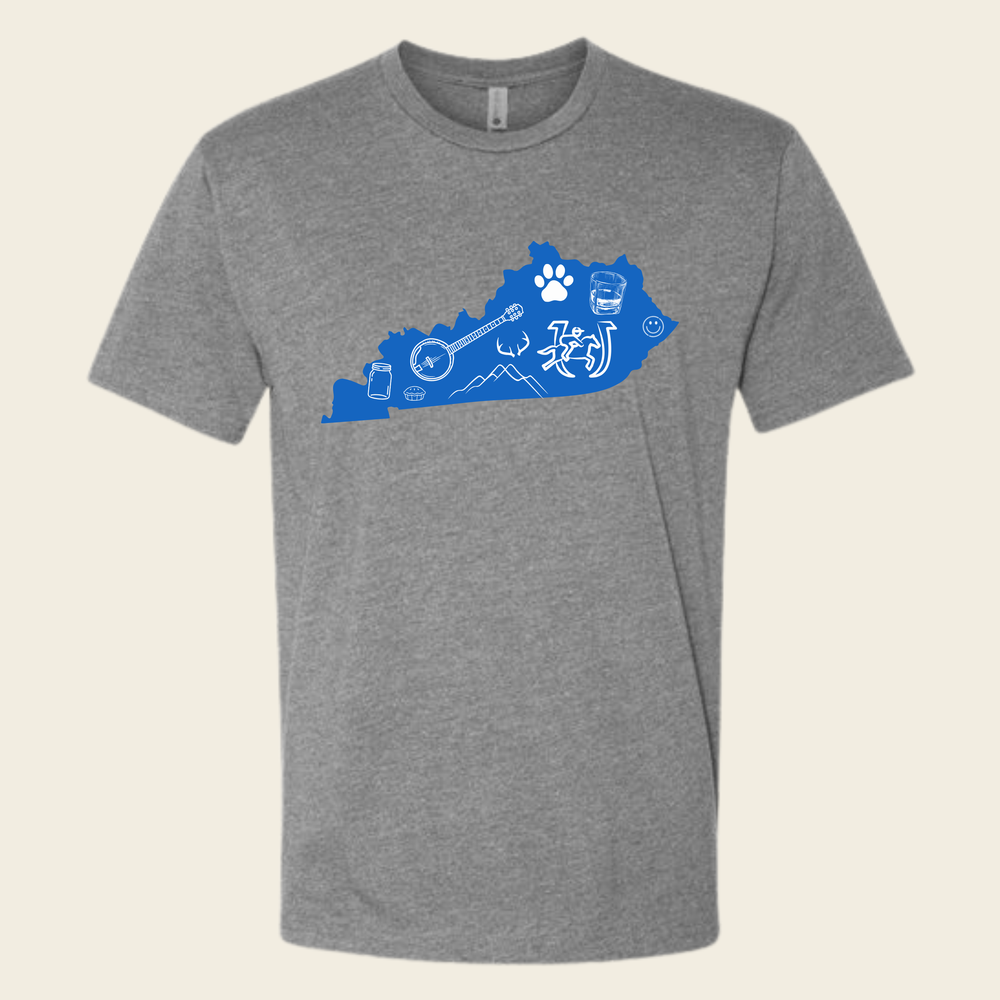
Ask someone from Bowling Green and someone from Ashland what Kentucky is like and you'll get two honest answers that barely overlap. This is part of why a design that tries to sum the state up has to work hard, and why the Kentucky Icons Tee leans on symbols rather than a single scene — no single scene covers it.
The food is not fried chicken
Or not only, and not mainly. The Colonel is the state's most famous export and the least representative of what people actually cook and eat there. The list you should know instead:
- Owensboro barbecue, which means mutton, slow-smoked and served with a thin, vinegary dip. Almost nowhere else in America barbecues sheep. Western Kentucky does it as a matter of course.
- Burgoo, a thick stew that traditionally contained whatever was on hand and now usually contains several meats and an argument about the recipe.
- The Hot Brown, an open-faced turkey sandwich drowned in Mornay sauce, invented at the Brown Hotel in Louisville and still served there.
- Beer cheese, a sharp, spreadable institution from the Winchester area, eaten with crackers and strong opinions.
- Ale-8-One, a gingery soft drink bottled in Winchester that Kentuckians buy by the case and expats make people mail to them.
None of this comes in a bucket.
Bourbon is real, but it's not a theme park
Here the stereotype is directionally correct — the great majority of the world's bourbon is made in Kentucky, and the distillery trail through places like Bardstown and Frankfort is worth the drive. What people get wrong is the texture. Bourbon country isn't a strip of tasting rooms. It's working agricultural and industrial land where the rickhouses sit out in fields, black-streaked from the fungus that feeds on evaporating whiskey, and the towns between them are ordinary towns where people have regular jobs, some of which happen to involve barrels.
The other mistake is assuming everyone in Kentucky drinks bourbon and talks about mash bills. Plenty of the state is dry or was until recently, county by county, and the local relationship with whiskey is more complicated and more interesting than the marketing suggests.
Basketball is not a hobby, it's an alignment
Outsiders know Kentucky likes basketball. What they miss is the structure of it. There is no meaningful professional team loyalty in the state; the college programs fill that role entirely, and the Kentucky–Louisville divide runs through workplaces, churches, and marriages. You declare early, usually by inheritance, and you do not switch. The Wildcats' fan base extends into every county, including ones a five-hour drive from Rupp Arena, and high school basketball in the small towns draws crowds that would embarrass some college programs elsewhere.
March in Kentucky is a season with its own weather. Plan accordingly.
It's not the Deep South, and it's not the Midwest either
People file Kentucky under "the South" and move on. Kentuckians themselves are less sure. The state was a border state that never seceded, the accent shifts noticeably as you cross it, and Louisville and Northern Kentucky look across the Ohio River at Indiana and Cincinnati every day. Meanwhile the eastern mountains are Appalachian, which is its own category that resists both labels.
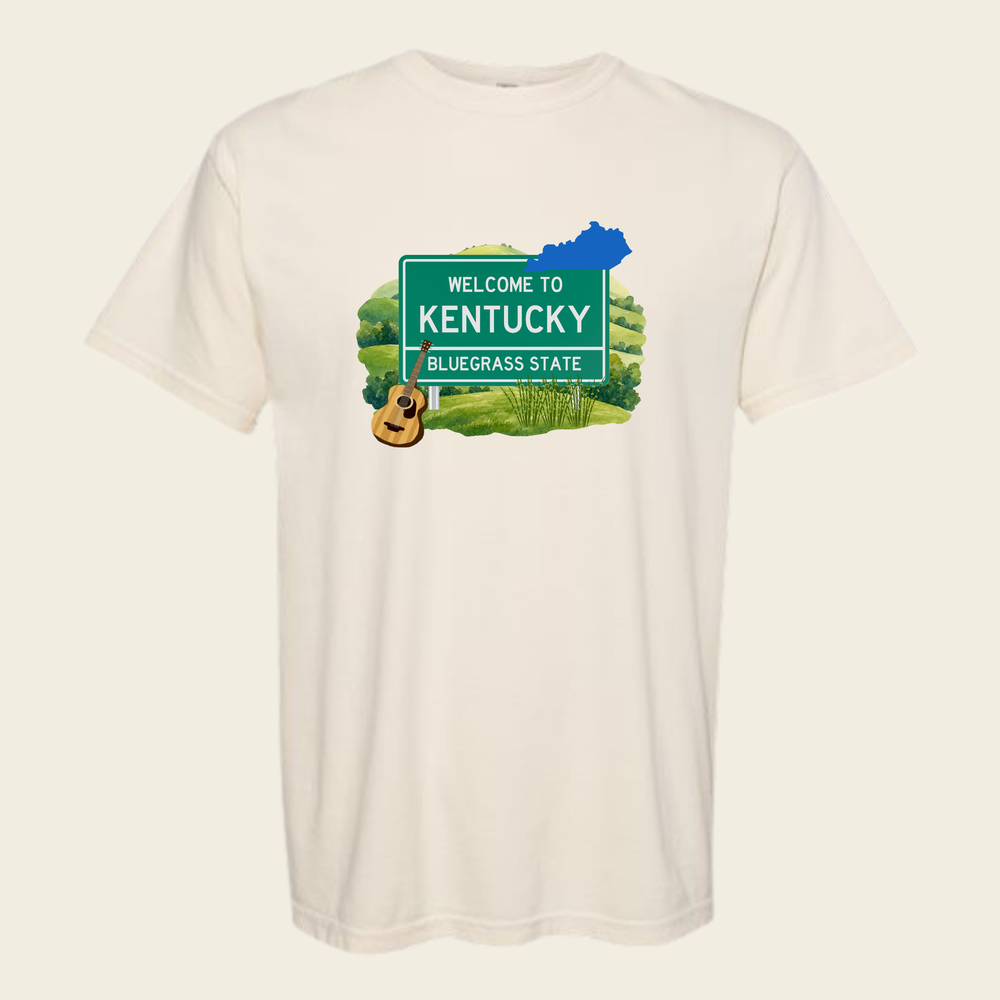
The honest answer is that Kentucky is a hinge — between North and South, between Appalachia and the Mississippi basin, between horse-farm gentility and hollow-road self-reliance. That in-betweenness is the state's actual identity, and locals tend to like it that way. It's part of why the roadside sign is such a durable image there; crossing into Kentucky feels like crossing into somewhere specific, which is more or less the whole idea behind the Welcome to Kentucky Tee.
What to actually do there
If you're passing through and want the real thing rather than the postcard:
- Hike or climb in the Red River Gorge, then eat pizza at the trailhead spots everyone will point you to.
- Take the cave tour at Mammoth Cave, the longest known cave system on Earth, and pick a tour longer than the shortest one.
- Eat mutton in Owensboro and burgoo wherever you find it.
- Drive the back roads of Woodford or Bourbon County in late afternoon light and understand why people paint this landscape.
- Go to a high school basketball game in a small town. Any small town.
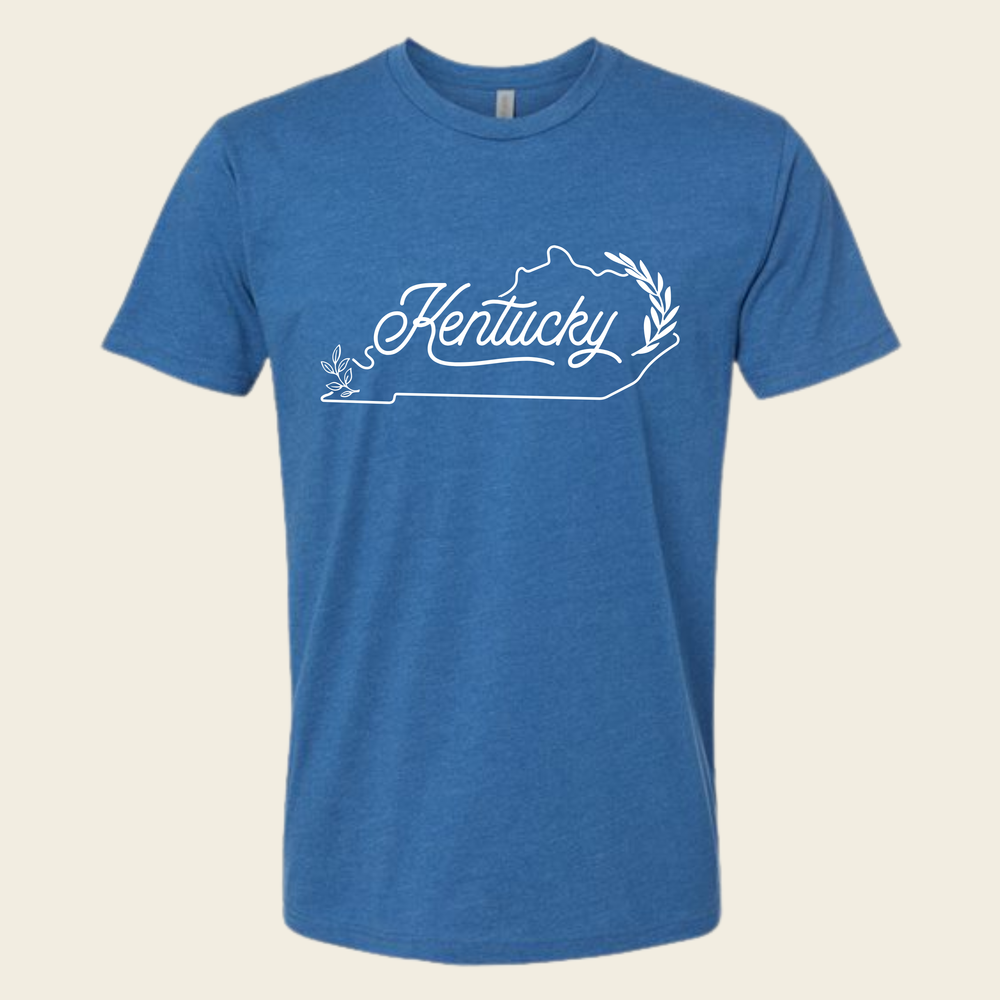
Do a few of those and the stereotypes fall away on their own. The rest of what we make about the state lives in the Kentucky collection, including the plain-and-simple Script Kentucky Tee for people who don't need the state explained to them.
Common questions
Is Kentucky in the South or the Midwest?
Neither cleanly. It was a border state that never left the Union, and today the east feels Appalachian, the south feels Southern, and Louisville and Northern Kentucky lean toward the Midwest. Kentuckians mostly enjoy the ambiguity.
Is there anything to do in Kentucky besides bourbon and the Derby?
Plenty. Mammoth Cave is the longest known cave system in the world, the Red River Gorge is a world-class climbing destination, Cumberland Falls produces a moonbow, and western Kentucky's lakes region is built for boats. The bourbon and the horses are real, but they're the trailer, not the movie.
What food is Kentucky actually known for?
Locally: Owensboro mutton barbecue, burgoo, beer cheese, the Hot Brown, and Ale-8-One. Fried chicken exists, but it's the export version of the state, not the home cooking.
Kentucky

Made by Land & Light — American lifestyle apparel with a sense of place and a sense of humor.
See every shirt