
What Locals in Texas Say That Nobody Else Does
Fixin' to, might could, feeder roads, and why every soda is a coke — a field guide to talking like a Texan.
Texans have a working vocabulary that the rest of the country mostly doesn't use: fixin' to, might could, all y'all, tump, feeder road, blue norther. Some of it is shared with the broader South, but the full set together — plus the road talk and the weather talk — is distinctly Texan.
If you grew up there, none of this reads as slang. It reads as English. If you moved there, you'll pick most of it up within a year without noticing, and then you'll say fixin' to in a meeting in another state and get a look. Here's the list, with usage notes.
Y'all, all y'all, and fixin' to
Y'all is not exclusive to Texas, but Texas may be its most confident user. It fills a real gap — English lost its plural you and y'all is the best replacement anyone has come up with. The refinement is all y'all, which is not redundant. Y'all can mean two people. All y'all means everyone present, no exceptions. "Y'all coming to dinner?" is a question for the couple. "All y'all need to get out of my kitchen" is addressed to the room.
Fixin' to means about to, but softer. "I'm fixin' to head out" means departure is imminent but not scheduled. It could be two minutes. It could be forty-five. The phrase commits you to the intention, not the timeline, which is a very Texan distinction. You will also hear it stacked: "I was fixin' to call you." That one means the person was not fixin' to call you.
Might could, and other double modals
Standard English says you can have one modal verb per clause. Texas disagrees.
- Might could — possibly able to, with no commitment. "I might could get out there Saturday" is a maybe wearing a hat.
- Might oughta — should, probably, said gently. "You might oughta check the oil before you drive to Lubbock."
- Used to could — was once able to. "I used to could touch the rim." Past tense, past glory.
Linguists have names for this. Locals do not, because it doesn't need one. Double modals let you hedge politely, and Texans hedge politely as a way of life. A flat no is rude. "I might could" gets you out of most things without anyone's feelings getting hurt.
Every soda is a coke
In much of Texas, coke is a category, not a brand. The exchange goes like this: "You want a coke?" "Sure." "What kind?" "Dr Pepper." No one involved finds this strange. Dr Pepper itself is a point of state pride — it started in Waco, and Texans treat it accordingly, the way other states treat a founding document.
Related food vocabulary that marks you as local: knowing that the sausage-filled pastry at the donut shop is technically a klobasnek even though everyone calls it a kolache, and being willing to argue about that distinction at 7 a.m. Ordering "a number one with a coke" at Whataburger and specifying spicy ketchup. Calling any gathering with a smoker involved a cookout unless brisket is present, in which case it's a barbecue, and those are not the same event.
Road talk: feeders, FM roads, and the loop
Texas has its own highway dialect, and it varies by city, which is how locals identify each other.
- The feeder — in Houston, the road running alongside the freeway. Other places call it a frontage road or access road or service road. In Houston it is the feeder, and directions will assume you know that. "Get off at Shepherd and stay on the feeder."
- FM roads — farm-to-market roads, numbered, covering the rural parts of the state. Nobody says "farm-to-market" out loud. It's "FM 1960" or just "1960" if you're from north Houston.
- The loop — every major Texas city has one and refers to it with the definite article. In Houston it's the Loop, and living "inside the Loop" is a whole identity. San Antonio has 1604 and 410. Austin argues about MoPac, which is a highway named after a railroad, which nobody explains to visitors.
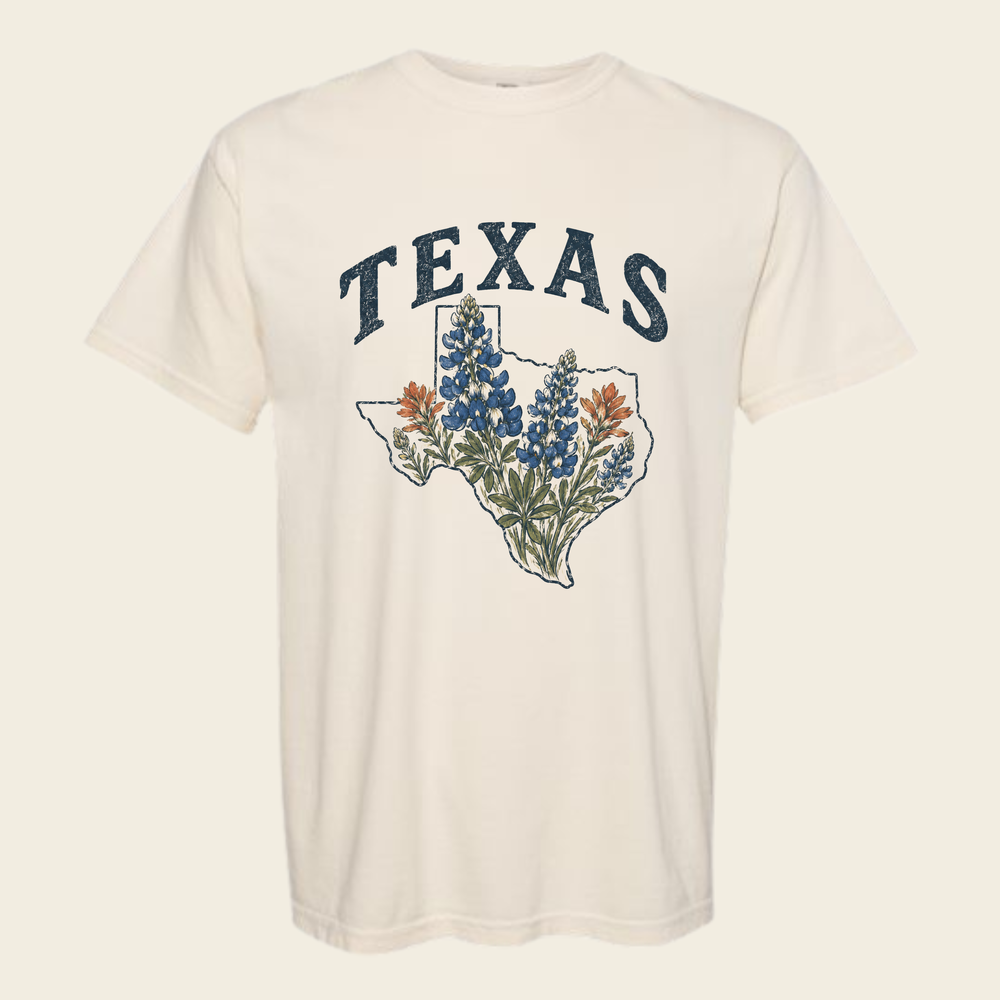
Spring adds a seasonal ritual to the FM roads: driving out to find bluebonnets and photographing children sitting in them, a tradition so established that the flower is basically a family member. It's the same flower on the Texas Bluebonnet Tee, which is about as close as you can get to carrying April in the Hill Country around with you the rest of the year.
Weather words for weather that earns them
Texas weather is dramatic enough to need its own terms, and it has them.
A blue norther is a cold front that arrives like a decision — the sky goes dark blue-gray to the north and the temperature falls fast, sometimes dramatically, within hours. Locals talk about them the way sailors talk about squalls. A gully washer is a rainstorm heavy enough to fill the bar ditches, which is another term: the drainage ditch along a country road is a bar ditch, and no one agrees on why.
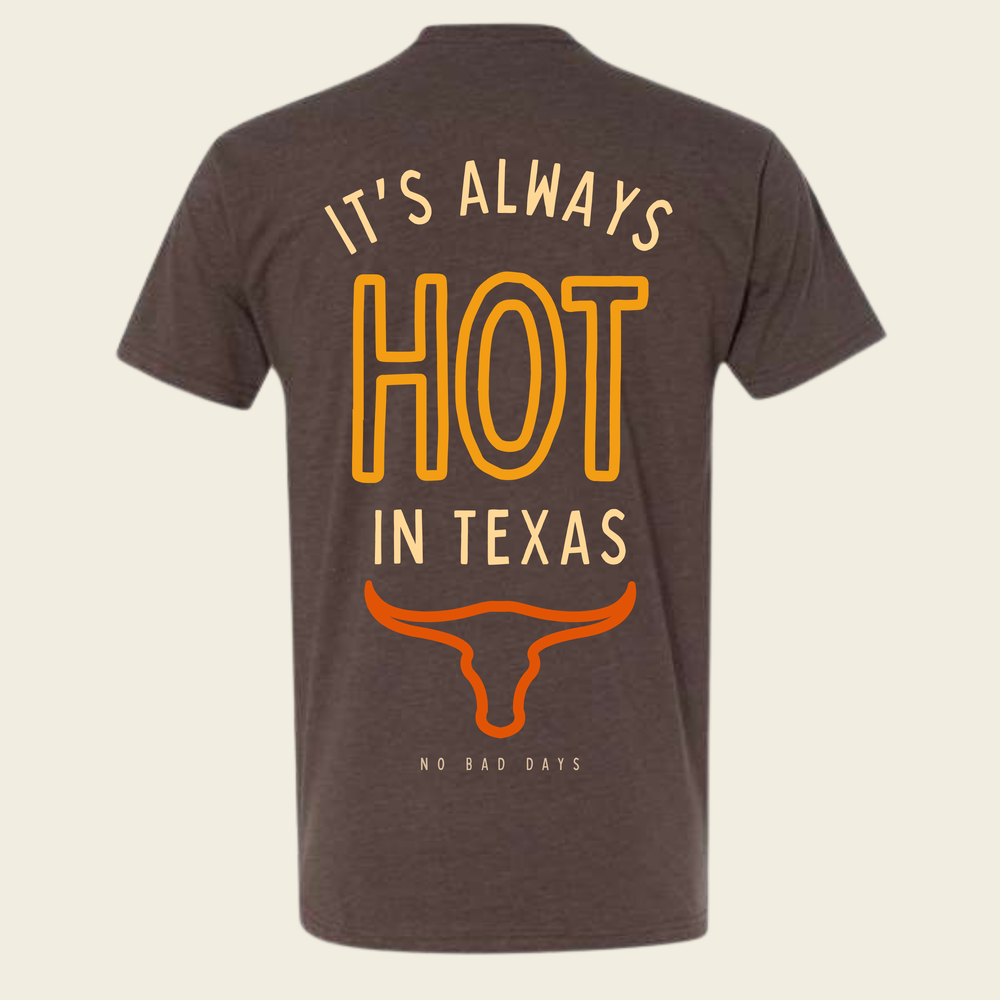
Then there's the summer vocabulary, which is mostly resignation. "Hot enough for ya" is not a question. "It's not the heat, it's the humidity" is Houston's motto in all but name. And somewhere around the second week of triple digits, everyone stops mentioning the weather at all, because there's nothing left to say. The Hot in Texas Tee covers that entire season in three words, which is the correct number of words to spend on August.
The words nobody outside Texas has
A few entries that reliably confuse people from elsewhere:
- Tump — to tip over, usually with contents spilling. "The canoe tumped over." "He tumped his coffee." There is no better word for this and other states are simply doing without.
- Tank — a pond, usually man-made, on ranch or farm land. A stock tank. If someone invites you to fish the tank, do not expect metal.
- Ugly — rude or mean, as behavior. "Don't be ugly to your sister" has nothing to do with appearance.
- Whenever — used where others say when, for a one-time past event. "Whenever I graduated high school" describes something that happened exactly once.
- All hat, no cattle — someone whose presentation exceeds their substance. Still the most efficient character assessment in American English.
- Howdy — alive and well, unironically, especially in College Station, where it is practically institutional.
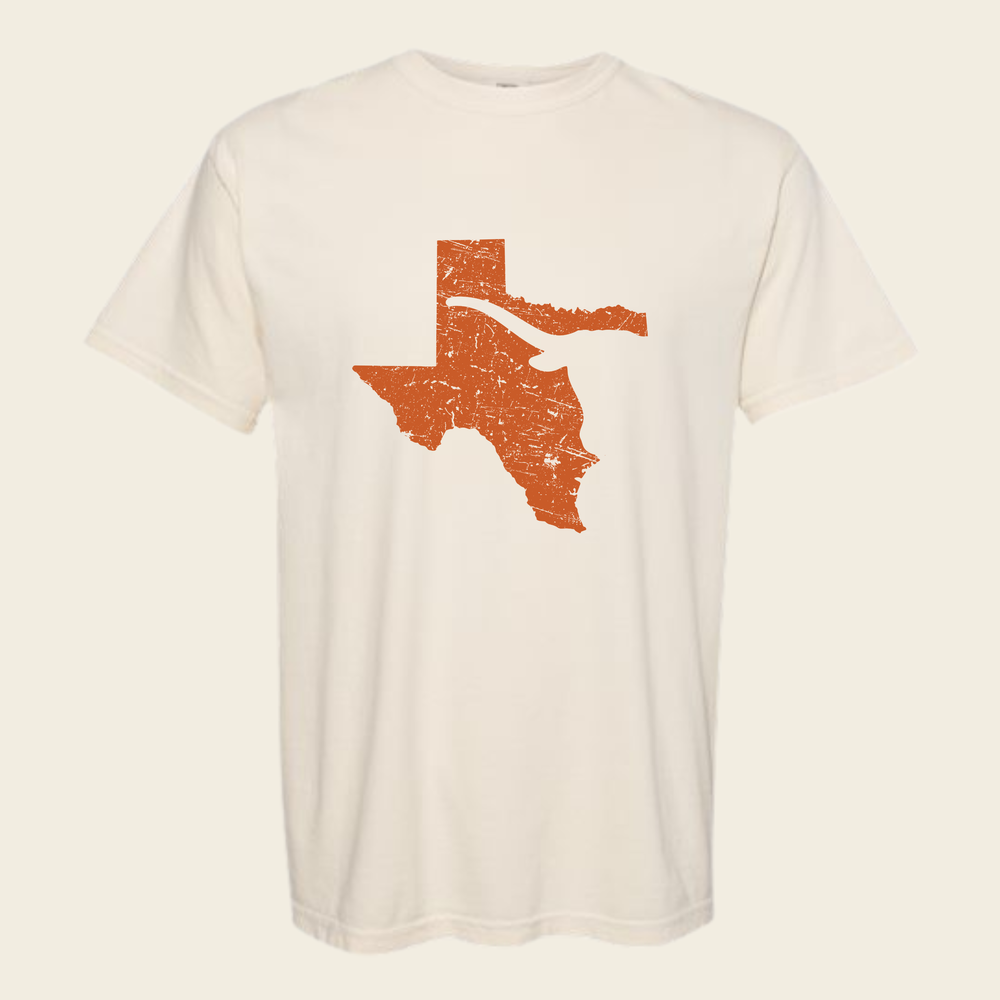
And then there are the hand signs, which count as vocabulary. Horns up means something specific in Austin and something else entirely to an Aggie, and both parties feel strongly about it. The Texas Horns Tee knows which side it's on.
Why the talk sticks
Texans keep this vocabulary because it works and because it marks home. Fixin' to is genuinely more useful than "about to." Tump has no substitute. The feeder is faster to say than "frontage road." And the whole set functions like a passport — say "might oughta" in a diner in Amarillo and you're understood; say it in Boston and you've announced where you're from.
That's the appeal, really. Texans famously do not stop being Texan when they leave, and the language travels with them, along with the Dr Pepper preference and the strong opinions about brisket. If the words travel with you too, the Texas collection is built on the same idea — the state as a place you carry, not just a place you're from.
Common questions
Is "y'all" only a Texas thing?
No — y'all is used across the South and beyond. Texas didn't invent it, but Texans use it universally and unapologetically, and "all y'all" as the emphatic plural is strongest in Texas and the Deep South.
What does "fixin' to" actually mean?
It means "about to," but with a loose timeline. "I'm fixin' to leave" signals intent to leave soon without promising exactly when. It's one of the most reliable markers of Texas and Southern speech.
Why do Texans call every soda a coke?
In much of Texas and the South, "coke" functions as a generic word for any soft drink, so the follow-up question "what kind?" is normal. Elsewhere in the country the generic term is usually "soda" or "pop," which is one of the fastest ways to tell where someone grew up.
Texas
Made by Land & Light — American lifestyle apparel with a sense of place and a sense of humor.
See every shirt