
What Ohioans Say That Nobody Else Does
O-H, devil's strip, "please?", needs washed — a field guide to the words and habits that mark someone as actually from Ohio.
Ohioans have a whole vocabulary that stops working the moment you cross the state line: they yell "O-H" at strangers, say "please?" when they didn't hear you, and tell you the car needs washed. None of it is an accent exactly. It's more like a set of passwords, and locals use them without noticing until someone from out of state stares back blankly.
If you grew up there, most of this list will read as normal. That's the point. Here's what to listen for.
O-H. (You're supposed to answer.)
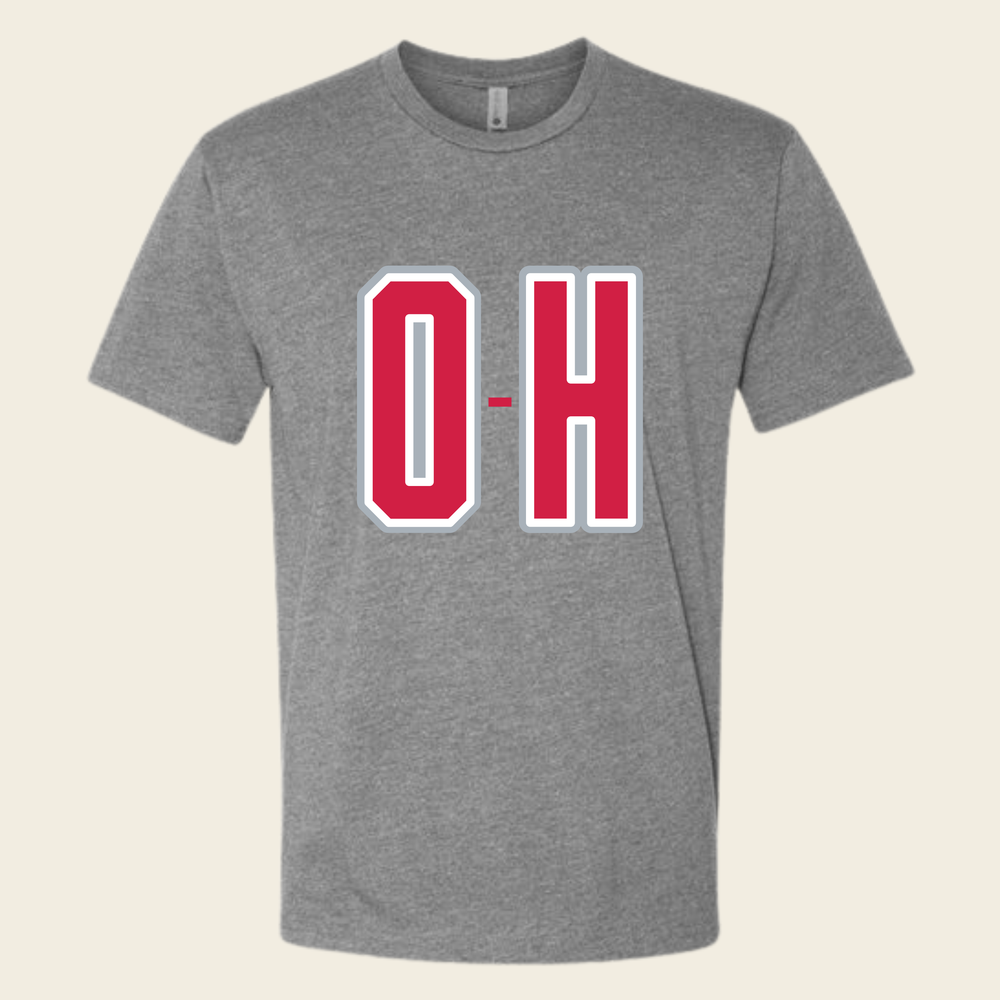
Start with the big one. In Ohio, "O-H" is not a statement. It's a question, and the only correct answer is "I-O." It works in airports, at weddings, across parking lots, and shouted between cars at a red light on High Street in Columbus. Someone in a scarlet hat will say the first half to a complete stranger and the stranger will finish it, because leaving an O-H hanging in the air feels genuinely wrong to anyone who went to a Saturday game at the Shoe, or who just grew up near someone who did.
It's also a hand-gesture language. Four people at a tailgate will spell it out with their arms. Two people will split the job. It has been performed on mountaintops, in stadiums belonging to other teams, and in at least one wedding party photo per weekend in central Ohio. The O-H Tee exists for exactly this reason — half the call and response, worn on your chest, waiting for a stranger to complete it.
"Please?" — the Cincinnati question
In most of America, if you don't hear someone, you say "what?" or "sorry?" In Cincinnati, you say "please?" It's a single word, rising at the end, and it means "say that again." The usual explanation traces it back to the city's German-speaking settlers — a direct carryover from asking "bitte?" — and whatever the exact history, it stuck hard along the Ohio River and mostly nowhere else.
The fun part is that Cincinnatians often don't know it's regional. They'll use it in a job interview in Denver and get a confused look, because to the other person it sounds like they're being asked to repeat themselves more politely. If you hear "please?" as a standalone question, you are talking to someone from the southwest corner of Ohio. It's nearly diagnostic.
The devil's strip and the tree lawn
The patch of grass between the sidewalk and the street doesn't have one national name, and Ohio proves it by having two of its own, a few miles apart.
- Devil's strip — Akron. This is the famous one, the term dialect researchers love, and Akronites are proud of it. Nobody fully agrees on why it's the devil's, but it is.
- Tree lawn — Cleveland and much of northeast Ohio. Plainer, but just as local. Put your trash cans on the tree lawn.
- Berm — parts of southern and rural Ohio use this for the road shoulder, which confuses everyone who thinks a berm is a hill.
Ask three Ohioans what that grass strip is called and you can roughly map where each of them grew up. Try it. It's a better icebreaker than the weather.
Grammar you didn't know was local
Some of the strongest Ohio markers aren't words at all. They're constructions.
- "Needs washed." The car needs washed. The grass needs cut. The dishes need done. Much of Ohio drops the "to be" entirely, and speakers usually have no idea it's regional until an East Coast editor circles it in red.
- "Anymore" at the start of a sentence. "Anymore, I just take 71." Elsewhere, "anymore" needs a negative. In Ohio it can simply mean "these days."
- "Sweeper" for a vacuum cleaner. You run the sweeper. Nobody vacuums.
- "Warsh." The intrusive R lives on in plenty of Ohio households, especially the further you get from the big cities. You warsh the car (which, again, needed washed).
- "Ope." The involuntary Midwestern syllable produced when you bump into someone or reach past them at Kroger. Usually followed by "let me just sneak past ya." Ohio shares this one with its neighbors but deploys it constantly.
The state up north
Ohioans have a word they refuse to say, and that refusal is itself a piece of the dialect. In Buckeye country, Michigan is "that team up north" or "the state up north," a habit tied to decades of Ohio State football tradition and taken seriously enough that some fans cross out the letter M in writing. The last Saturday of November reorganizes the whole state. Errands get done early. Basements fill up. Grown adults get superstitious about which chair they sat in last year.
You don't need a ticket to Ohio Stadium to participate. You need scarlet and gray, an opinion about the offense, and something like the Ohio State Pride Tee, because in late November wearing the wrong colors in Columbus gets you a look, and wearing the right ones gets you a conversation with a stranger about the game.
Pop, buckeyes, and a three-way
The food and drink vocabulary is its own dialect zone.
- Pop. Not soda. Not coke-as-a-category. Pop. Ordering "a soda" in much of Ohio marks you as a visitor immediately.
- Buckeye. Outside Ohio, a poisonous nut. Inside Ohio, a peanut butter ball dipped in chocolate with a bare circle left on top so it looks like the nut, made by somebody's grandmother in industrial quantities every December. Also the state tree, the mascot, and what Ohioans call themselves.
- A three-way. In Cincinnati this means spaghetti, chili, and a pile of shredded cheddar, and locals will say it in public without blinking. A four-way adds onions or beans. A five-way adds both. The chili itself — thin, sweet-spiced, ladled over pasta — is a whole separate argument.
- Pony keg. Also Cincinnati: a small corner store or drive-through where you buy beer, whatever size the keg actually is.
- Cornhole. The bean bag game. Cincinnati claims it as its own invention, and whether or not that history holds up, Ohioans talk about "boards" and "bags" with tournament-level seriousness at every graduation party in the state.
Why any of this sticks
Ohio sits at a crossroads — Appalachian speech coming up from the south, German influence in the river cities, Great Lakes vowels along the top edge — so the state ended up with pockets of language that don't match each other, let alone the rest of the country. A Clevelander and a Cincinnatian can disagree about the grass strip, the chili, and whether "please?" is a normal thing to say, and both are speaking fluent Ohio.
That's the appeal, honestly. These aren't marketing slogans; they're passwords people carry without thinking. We make shirts about that kind of thing — the phrases and places that only land if you've lived them — and the Ohio collection is built from this exact material. If "needs washed" sounds correct to you, you'll recognize yourself in it.
Common questions
What does "O-H" mean and how do you respond?
It's the first half of a call and response tied to Ohio State: one person says "O-H" and the other answers "I-O," spelling Ohio between them. It works between total strangers, anywhere in the world. Leaving it unanswered is considered genuinely rude in-state.
Why do people in Cincinnati say "please?" instead of "what?"
It's a local habit generally traced to the city's German heritage, echoing the German use of "bitte?" to ask someone to repeat themselves. It survives mainly in and around Cincinnati, and many locals don't realize it's unusual until they leave.
What is the devil's strip?
It's the Akron, Ohio term for the strip of grass between the sidewalk and the street. Cleveland calls the same thing a tree lawn, and most of the country has no fixed word for it at all, which is why dialect researchers love asking Ohioans about it.
Made by Land & Light — American lifestyle apparel with a sense of place and a sense of humor.
See every shirt