
A Quieter Indian River Lagoon Win: The C-23 Diversion Project Is Done
Florida just finished the C-23 Canal diversion project, rerouting excess water away from the St. Lucie Estuary and Indian River Lagoon.
Here's a piece of good news that doesn't need dressing up: Florida officials announced in early September that the C-23 Canal Estuary Discharge Diversion Project has been completed, as reported by 1290 WJNO. It means less dirty canal water dumping into the St. Lucie Estuary and the Indian River Lagoon — two waterways that have taken more than their share of punishment over the years.
What happened
This month, the Florida Department of Environmental Protection and the South Florida Water Management District marked the completion of the C-23 project, which reduces harmful discharges to the St. Lucie Estuary by routing excess water from the C-23 Canal to the C-44 Reservoir and Stormwater Treatment Area. In plain terms: instead of flushing nutrient-heavy canal water straight into a fragile estuary, the system now sends it to a reservoir and treatment area where it can be stored and cleaned first.
It's a key piece of the larger Everglades Restoration Project, built specifically to protect the Indian River Lagoon. Not a ribbon-cutting for something that might work someday — finished infrastructure, moving water the right direction, starting now.
Why it matters
If you've spent any time on the Treasure Coast, you know the pattern. Heavy rain fills the canals, the canals dump into the estuary, and the estuary pays for it — murky water, stressed seagrass, unhappy fish, unhappy people. Rerouting that water before it hits the St. Lucie is exactly the kind of unglamorous plumbing fix that adds up to clearer water over time.
And the lagoon is worth the effort by any measure you like. According to NOAA Fisheries, the Indian River Lagoon generates $28.3 billion in local economic activity each year and supports 128,400 jobs and $8.3 billion in wages annually. That's fishing guides, bait shops, waterfront restaurants, kayak outfitters, and every small business within a cast of the water. When the lagoon does well, a very long stretch of Florida's east coast does well with it.
Part of a bigger comeback story
This isn't happening in isolation. NOAA has documented a broad, system-wide restoration push on the lagoon, where federal funding helped assemble a wide partnership of restoration practitioners to tackle the complex problems facing the waterway. There are even encouraging signs from the shellfish side of things: out-planted clams are still growing two years after being placed in the wild — clams being the quiet little water filters that estuaries love.
Nobody's declaring the lagoon fixed. But engineered water fixes on one end and living shoreline work on the other is what a real recovery looks like — slow, layered, and stubborn. Very Florida, in the best way. It's the kind of thing we think about when we design our Florida collection — the state beyond the postcard, the one people actually work to take care of.
Go see the water it's protecting
The best way to appreciate this news is from a kayak or a dock. The Indian River Lagoon runs along much of Florida's Atlantic coast, and the towns along it — Stuart, Fort Pierce, Vero Beach, Sebastian — are easy places to spend a weekend. Paddle at sunrise, get a grouper sandwich somewhere with a screen porch, and watch for dolphins working the flats. If you want to do more than look, lagoon-area conservation groups regularly host shoreline cleanups and volunteer days — an hour of picking up line and litter is a genuinely useful gift to the water.
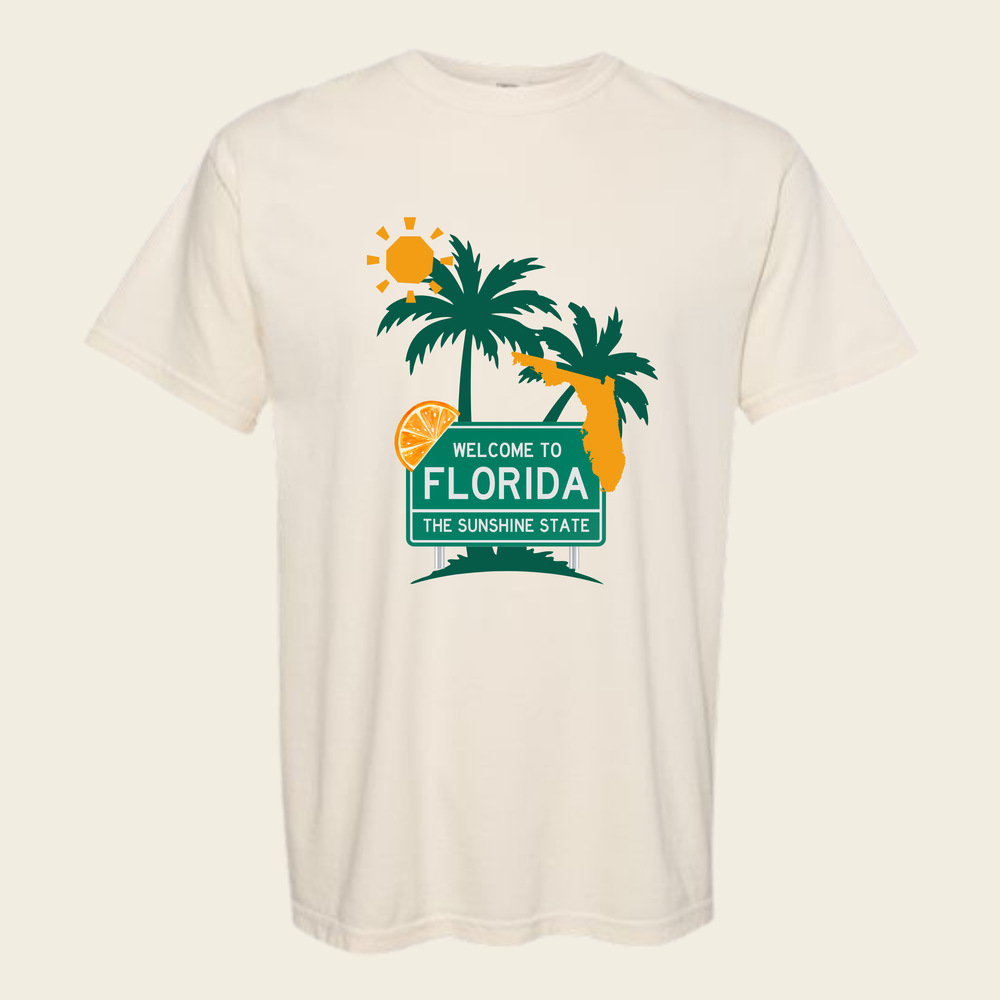
And if the trip puts you in a Florida state of mind, our Welcome to Florida Tee travels well from boat ramp to breakfast counter.
Common questions
What does the C-23 project actually do?
It reduces harmful discharges to the St. Lucie Estuary by routing excess water from the C-23 Canal to the C-44 Reservoir and Stormwater Treatment Area — storing and treating water instead of sending it straight into the estuary.
Why should anyone outside the Treasure Coast care?
Because the Indian River Lagoon is one of the most economically and ecologically important waterways in the state — supporting billions in economic activity and over a hundred thousand jobs — and because cleaner water there is a template for cleaner water everywhere else in Florida.
Is the lagoon actually getting better?
It's a long road, but the signs are pointing the right way — new water infrastructure is complete, and restoration clams planted in the wild are still growing two years on. Progress on an estuary is measured in years, and the years are starting to stack up.
Reported by 1290 WJNO. Details as published at the time of writing.
Florida





Made by Land & Light — American lifestyle apparel with a sense of place and a sense of humor.
See every shirt