
The Case for the Short Hike
A short hike is a real hike. Most of what people go to the woods for shows up in the first mile, and there's no rule that says you have to keep going.
A short hike is a real hike. Most of what people go to the woods for — quiet, a view, the smell of pine and dirt, a reason to eat a sandwich outside — shows up inside the first mile or two, and nothing improves automatically just because you kept walking.
Somewhere along the way, hiking picked up a scoreboard. Miles logged, elevation gained, peaks bagged, apps that turn a walk into a report card. This post is a defense of the other thing: the hour-long loop, the half-mile to the overlook, the trail you can do after work and still be home for dinner. It is not a consolation prize. It is often the better call.
What the first mile actually gives you
Think about what changes in the first twenty minutes on a trail. The road noise drops out. Your phone stops mattering. Your breathing settles into a rhythm. You notice actual things — a woodpecker working a dead snag, water moving under a footbridge, the temperature falling as you drop into a hollow. That's the product. That's what people mean when they say they need to get outside.
The second hour of a hike gives you more of the same, plus blisters, plus arithmetic about daylight. Long hikes are worth doing, and some views can't be had any other way. But the idea that the experience only counts past some mileage threshold is a story sold by people who like suffering, or who sell trekking poles.
Short trails that punch above their weight
The country is full of walks where the payoff-to-effort ratio is almost embarrassing. A few kinds worth knowing:
- The paved summit push. Clingmans Dome in the Smokies is a half mile of steep pavement to the highest point in the park. People in flip-flops complain the whole way up and then go quiet at the top, because on a clear day the ridgelines stack up in blue layers as far as you can see.
- The waterfall walk. Nearly every state with hills has one — a short, well-worn trail to falling water. Laurel Falls in Tennessee, the gorge trails of the Finger Lakes in New York, Multnomah Falls off I-84 in Oregon. Loud water does something to a brain that a treadmill can't.
- The overlook off the parkway. The Blue Ridge Parkway and Skyline Drive are lined with pull-offs where a trail of well under two miles gets you to rock outcrops with hundred-mile views. Stony Man in Shenandoah is the classic: minimal effort, maximum vista, back at the car before your coffee's cold.
- The town trail. The rail-trail behind the high school. The nature preserve loop next to the county landfill that's somehow gorgeous in October. Nobody photographs these for magazines. They carry most of the actual hiking that happens in America.
Short hikes fit into a real life
This is the practical argument, and it's the strongest one. A long hike requires a day, decent weather, a body that's cooperating, and a group where nobody has a soccer game. That combination comes around a few times a year. A short hike requires ninety minutes and a parking spot.
- You can do it after work in the summer and still catch the light.
- You can do it with a four-year-old, a new puppy, a bad knee, or a parent in their seventies — often all at once.
- You can do it in questionable weather, because if the sky opens up, the car is fifteen minutes away.
- You can do it weekly, which matters more than doing something epic annually. The person who walks the same two-mile loop every Sunday knows that trail — where the trillium comes up in April, which oak dropped a limb in the last ice storm — in a way no through-hiker ever knows anything.
Frequency beats intensity for almost everything that's good for you. Hiking is no different.
You need almost nothing
The gear industry would like every walk in the woods to require a purchase. For a short hike, the list is short: shoes you can trust, water, a snack, and a layer if the weather might turn. That's it. No hydration bladder, no gaiters, no satellite messenger for the falls trail with a gift shop at the trailhead.
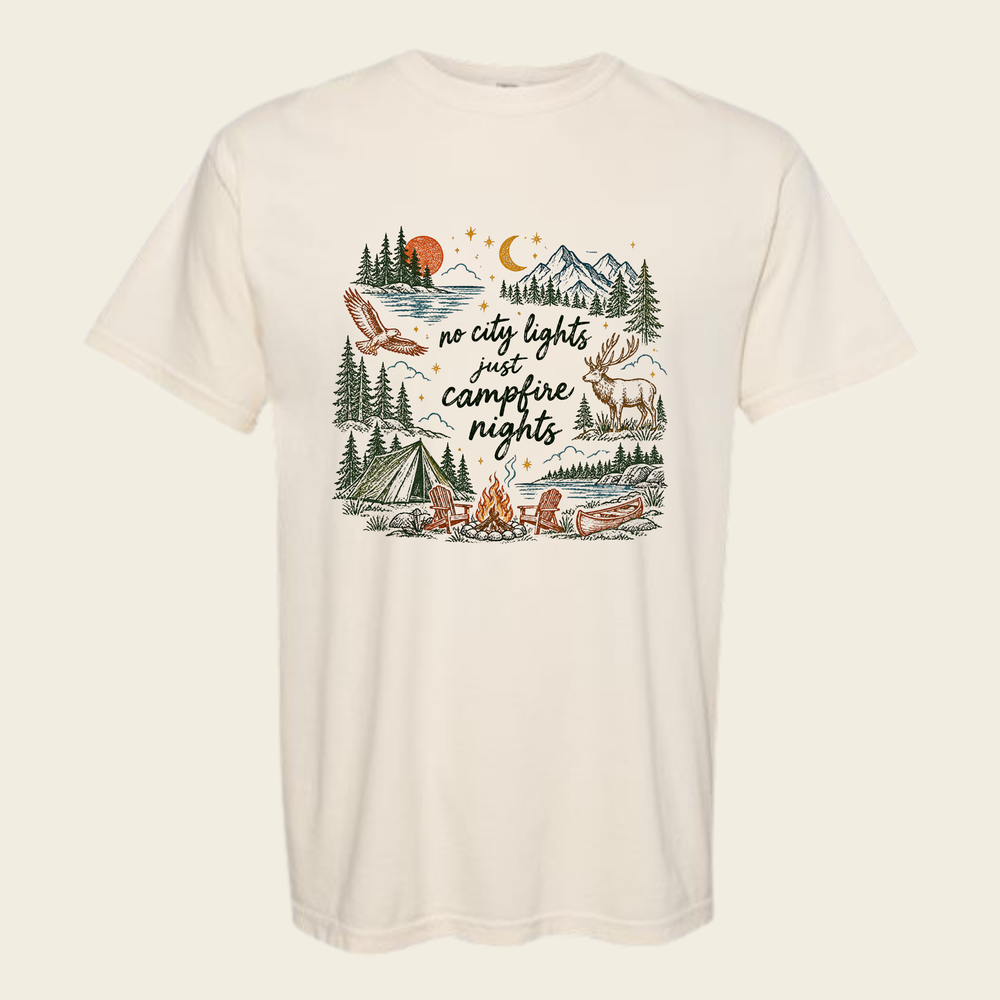
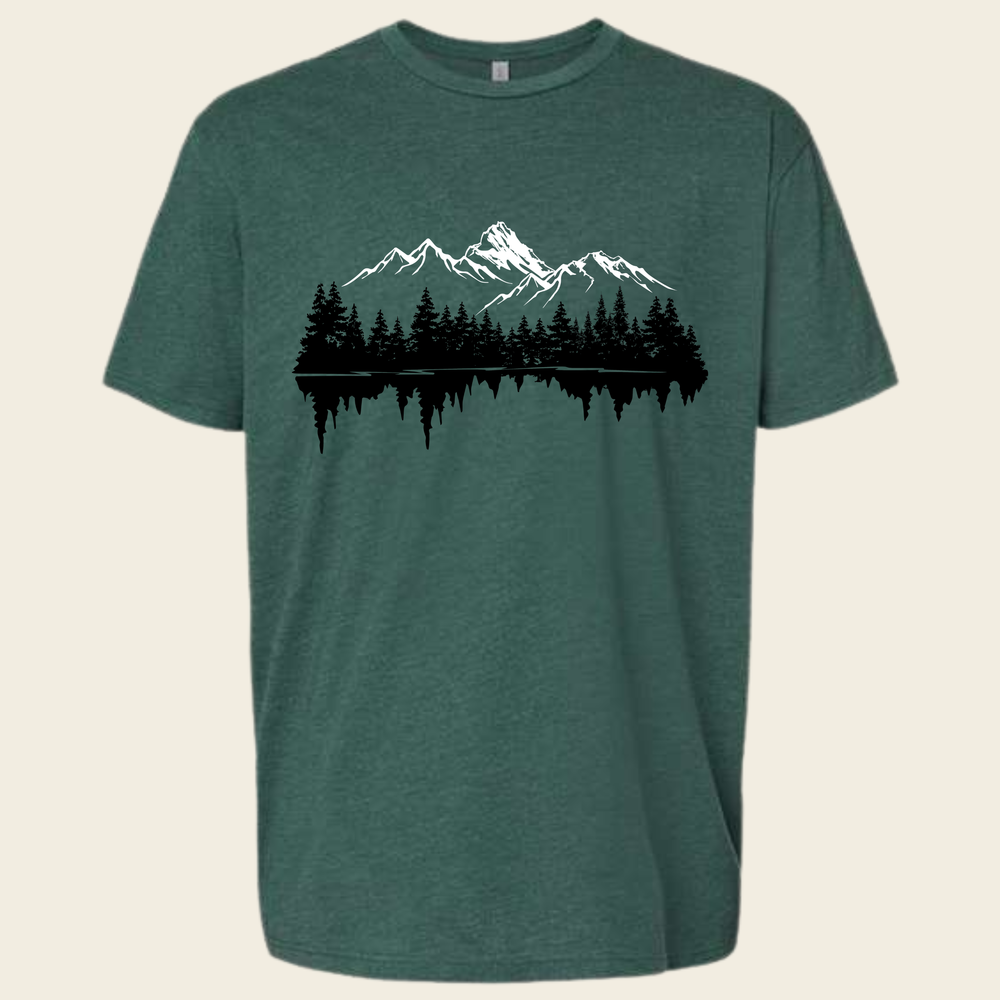
Wear whatever's comfortable. Around here that tends to mean a t-shirt — something like the Mountain Reflection Tee if the walk ends at an alpine lake, or the No City Lights Tee if the whole point of the outing was getting somewhere the streetlights don't reach. The rest of the outdoors collection runs on the same idea: the place is the point, the shirt just agrees with you.
The one real rule: bring more water than you think you need, even on a mile-long trail in July. Short doesn't mean shadeless.
How to make a short hike feel like a full one
The trick to a satisfying short hike is treating it like an occasion instead of an errand.
- Go at the edges of the day. The same half-mile overlook trail is a different place at 6:30 a.m. Empty lot, low light, deer still out. Sunset works too, if you bring a headlamp for the walk back.
- Stop at the destination. Don't tag the view and turn around. Sit down. Eat something. Twenty minutes on a rock at the overlook is worth more than the walking that got you there.
- Leave the earbuds in the car. An hour without input is most of the reason you came.
- Pick a season and repeat. Do the same trail in every month of the year once and you'll understand it better than any trail you've done a single time. Somewhere around the third trip you stop being a visitor.
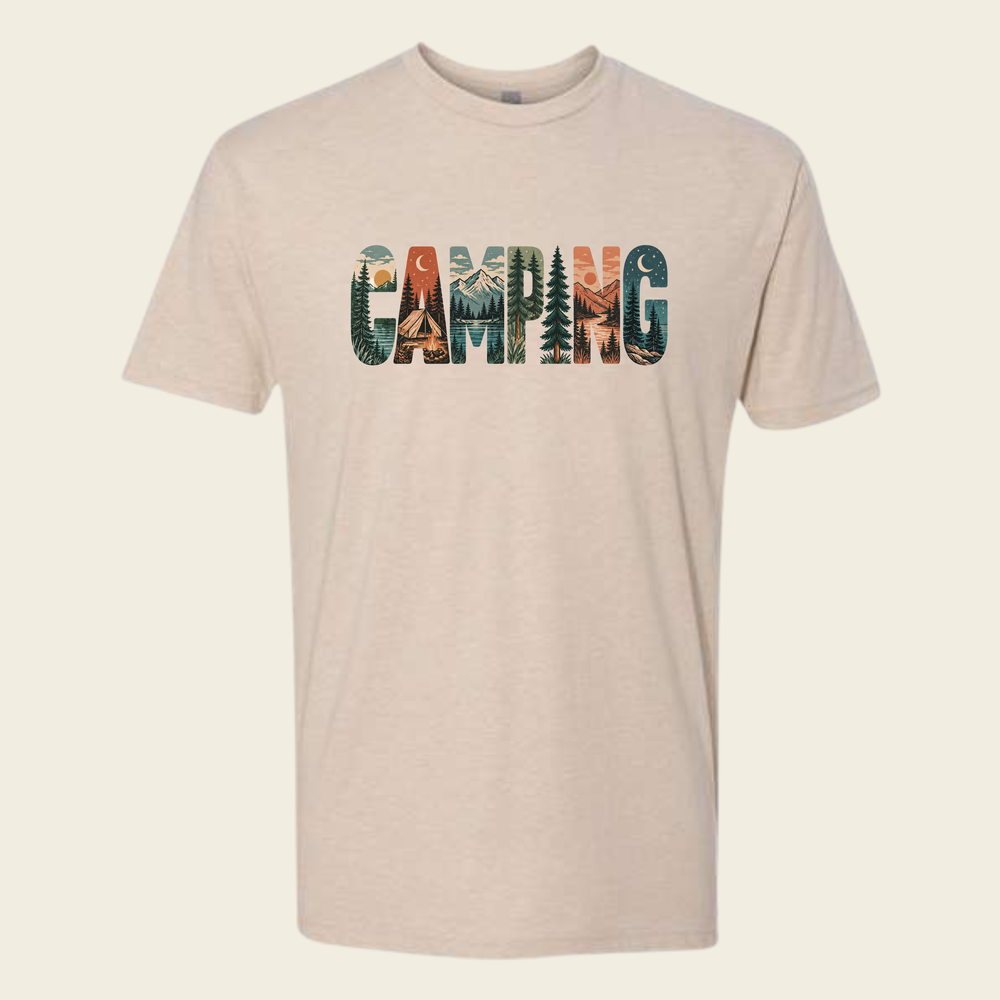
If the short hike is the opening act for a night at a campground — a leg-stretcher before the fire gets going — even better. That's the whole scene on the Camping Scenes Tee, more or less: small effort, big evening.
Nobody's checking your mileage
There's no ranger at the trailhead auditing your route. The mountain does not know whether you summited. The people who seem happiest on trails are rarely the ones moving fastest or farthest; they're the ones who stopped at the creek because the creek was good.
So take the short one. Take it often. Take it with people who'd never agree to twelve miles but will happily do two. The long hikes will still be there when the stars align. In the meantime, the overlook is forty minutes from your driveway, and the light this evening is supposed to be good.
Common questions
How long does a hike have to be to count as a hike?
There's no minimum. If you walked on a trail through some version of the outdoors and it did you some good, it was a hike. A half mile to a waterfall counts; the gatekeeping doesn't.
What should I bring on a short hike?
Water, a snack, decent footwear, and a layer if the forecast is uncertain. Add a headlamp if you're going near dawn or dusk, and tell someone where you're headed even if it's a trail you know well.
Are short trails too crowded to bother with?
The famous ones can be, at midday on weekends. Go early on a weekday morning and most of them are close to empty — the crowd problem is mostly a timing problem.
Outdoors


Made by Land & Light — American lifestyle apparel with a sense of place and a sense of humor.
See every shirt